“All of the information accumulated in a lifetime, we learn, is less than a drop in the ocean of information, and perhaps a creature that can collect more information and hold onto it longer is … more than human. In describing this vision of an evolving intelligence, Corinthians is evoked twice: ‘For now we see through a glass, darkly; but then face to face: now I know in part; but then shall I know even as I am known.”” —Roger Ebert’s review of the 1996 Ghost in the Shell
Category: General
Future You, With Me
Finally, we’re getting to a concept unveiling…
Future You with Elise Hu is a new video reporting journey that begins on April 9 on npr.org and other places where you find your videos — YouTube and Facebook. You’ll hear original radio versions of our episodes on Morning Edition.
Who will we be, as humans, in 2050? The question led us down a path to a fast-changing frontier in human evolution: The ways in which our biological brains, or human intelligence, is melding with artificial intelligence.
Science and technology are allowing us to augment our intelligence and capabilities in ways previous generations only imagined.
The world’s most prominent innovators are racing to decode the brain to unlock more possibilities for augmentation. Mark Zuckerberg announced that he is working to make a brain interface that will let people communicate via their thoughts. Bryan Johnson created Kernel and invested $100 million to make our neural code programmable. Elon Musk unveiled Neuralink, the company he founded to correct traumatic brain injuries and increase human intelligence.
The humans that exist thirty years from now could look quite different than the humans of today. When does augmentation … become alteration of the essence of humanity? The ethical and social implications abound. Future You takes audiences to the front lines of that change.
Strategic Alignment
We are a team of six producers, myself included. We’re dedicating our time and talent to this because of the potential to extend reach to people who don’t listen to NPR but watch video on YouTube or other platforms, to educators who can help expand NPR content into classrooms, and to young audiences who literally are the future.
The audience I feel most accountable to are the younger learners; I will be tickled if I hear from teachers that they are showing this to their kids as a jumping point to talk about the future. Sure, reaching other eyeballs is good, but I want to be committed to the audience I feel most accountable to so we don’t get distracted or, for that matter, disappointed.
Offering a video robust product like this one, with content that’s evergreen and tickles audience curiosities, allows us to deepen relationships with social platforms that help amplify our work and are hungry for more visual content. It opens up new possibilities for relationships with streaming services like Apple TV, Amazon, Hulu or Netflix. It’s a vehicle to more business reward opportunities through grants and sponsorships. On each of our organization-level strategic goals of reach, reward and relationships, this aligns.
A note about our creative process
Much like the innovators we’re tracking, as storytellers we’re only in phase one. April’s pilot begins a learning journey WITH our audiences on the best ways to follow this story and build engagement along the way. We want to complete the journey by the end of the season, but alongside the NPR community that joins us. So phase one is an opportunity for us to LEARN and CHANGE along the way. That means, we are flexible on our assumptions and ready to iterate as we go along.
Sex Recession
This is gonna be a perfect jumping off point for the next chapter of our exploration, on love and sex and reproduction in 2050.
Three Questions About The Human Body in 2050
To explore our first chapter of the 2050 project, I’m going to drill down on three questions or areas that seem to have the most movement right now:
- How will the human brain function by 2050? How much of it is the biological brain as we know it, and how much will be aided by an AI layer? What impact will that have on neurological disease i.e. Parkinson’s? Will brains be able to communicate with other brains using thought alone?
- What will it mean to age, or be old in years, in 2050? A tremendous amount of work right now is focused on the greying population and how to make someone who’s grown old not feel old. This is a crucial question as the developed world faces drastically aging populations without working-age populations to replace them. The United Nations projects that by 2050, 32 countries will have a greater share of senior citizens than Japan — well known for its population decline and preponderance of seniors — does now. (Note to self: Try out Cyberdyne exoskeleton at CES)
- What ‘superhuman’ powers will humans be capable of? Will humans function without sleep? How will our attention spans be able to be lengthened?
Project Update: Human Body Ideas
I’ve spent the past couple of weeks really immersing myself in futurism and people who think about the world on a timeline three decades out. That’s led me to a framework for our areas of inquiry that both holds up for organizing changes of the past — and can stand up to the changing winds of the future: human-centeredness. Each chapter can be organized by a basic human need.
I’m going to start exploring the human body, and what enhancements both biologically and technologically to humans-as-we-know-them will look and feel like by 2050, and the potential consequences and possibilities from that.
From that layer we can build out. From individual human bodies to human-to-human connections, with an exploration on love, sex and connection in 2050. And then further out, to human-to-human-human — communities and cities in 2050, where the urban question and transportation and such can be explored. The questions of economy, and power and governance could then flow from that, into another area of inquiry. But we’ll start with the most basic unit — the human body, and go from there.
So here are few angles I think we could hit for a single “episode” or chapter of this project. Each idea could be its own explainer and then we can piece them together for an episode.
-
- Past predictions for the human body, that is, how “futurists” of the 1980s believed humans would operate by our present. Will it need food and water to survive? How long will humans live in 2050? Will genetic disease be eradicated by then? What were PREVIOUS predictions for how humans would be by 2020? (The look back would be a feature of every chapter/episode).
- Everyone wants to live longer, but no one wants to grow old: The focus these days is increasing longevity while avoiding or delaying the stigmata of biological aging. Billions are now being spent to prove that advances in medicine will slow the aging process so that the average 90-year-old will feel as good as today’s 70-year-old. Google’s Calico is in the forefront of these efforts. Other companies have focused on specific diseases, but Calico is targeting the cellular degradation involved in aging that plays a role in most deadly diseases.
- Cryonic preservation: The Cryonics Institute in Michigan has over 100 people in “cryonic suspension” at its facility. SO MANY QUESTIONS. Alcor in Arizona charges $80,000 for “neurocryopreservation” (the head only) and $200,000 for the whole body but this includes all costs and perpetual maintenance. Cryopreservation can be covered by special insurance policies!
- Real time emotional state detection: Facial and tonal recognition analytics will help machine learning systems to detect consumers’ emotional state in real-time. Algorithms will harness your data in order to assess your predicted success at work, how likely you are to bounce around jobs and more. (This would then lead right into the 2050 dating/love chapter, in which future dating is predicated on systems that can read your physiological response to potential partners — you don’t even HAVE to decide!)
- Nanobots for targeted therapies: Teeny tiny robots could become mini-surgeons, squished into a pill that you swallow, under work being led by CSAIL at MIT. Because magnetic fields are able to transmit through our bodies without harming us, future surgeons could ask patients to ingest these nanobots and then direct them magnetically in order to deliver targeted therapies.
- Communicating with thought alone: At the University of Washington’s Center for Sensorimotor Neural Engineering, researchers built a system allowing one person to transmit his thoughts directly to another person. Using electrical brain recordings and a form of magnetic stimulation, one researcher sent a brain signal to another person elsewhere on campus, causing his finger to tap a keyboard. At Duke, researchers at the Center for Neuroengineering built a real-life Iron Man suit, allowing a young man suffering from complete paralysis of his lower body to walk out onto a soccer field and kick the first ball of the 2014 World Cup.
- Computerized Brains, and brain hacking. Devices implanted in your brain could function in two main ways: “Not only send signals to the brain as a means of treatment, but also gather data about the nature of these maladies.” There are several labs currently looking at ways in which computer interfaces will be operating within our brains, and the social implications of it. There is a cybersecurity angle in which brain hacking could become a thing. The hot brain implantation right now is neural lace: a new kind of flexible circuit implanted via injection, a grid of wires only a few millimeters across can insinuate itself with living neurons and eavesdrop on their chatter, offering a way for electronics to interface with your brain activity, perhaps curing diseases like Parkinson’s. (Engineers at Kernel, Charles Lieber at Harvard).
- NOTE: The Bergguen Institute here in LA has a dedicated topic area called “Transformation of the Human,” which we can partner with or report on as they explore the same area. I don’t know where it fits in but I am imagining using them as talking heads or as co-travelers/co-hosts in exploration. I have a visit scheduled with the head of the Transformation of the Human project on October 9. More info:
“Humans have historically defined themselves by contrast to machines and animals, by having language and intelligence, and by the idea of a soul. Just as earlier changes such as the evolution of language, literacy, and better nutrition changed what it means to be human, so are new technologies changing our material realities and thus destabilizing old definitions of the human. We are interested, for example, in artificial intelligence and gene editing, as well as developments in neuroscience, bio-engineering, and interventions into the human microbiome. At the same time, we recognize that changing social and cultural norms are part of the process of redefining of the human, not least as different civilizational traditions inform and challenge each other.”
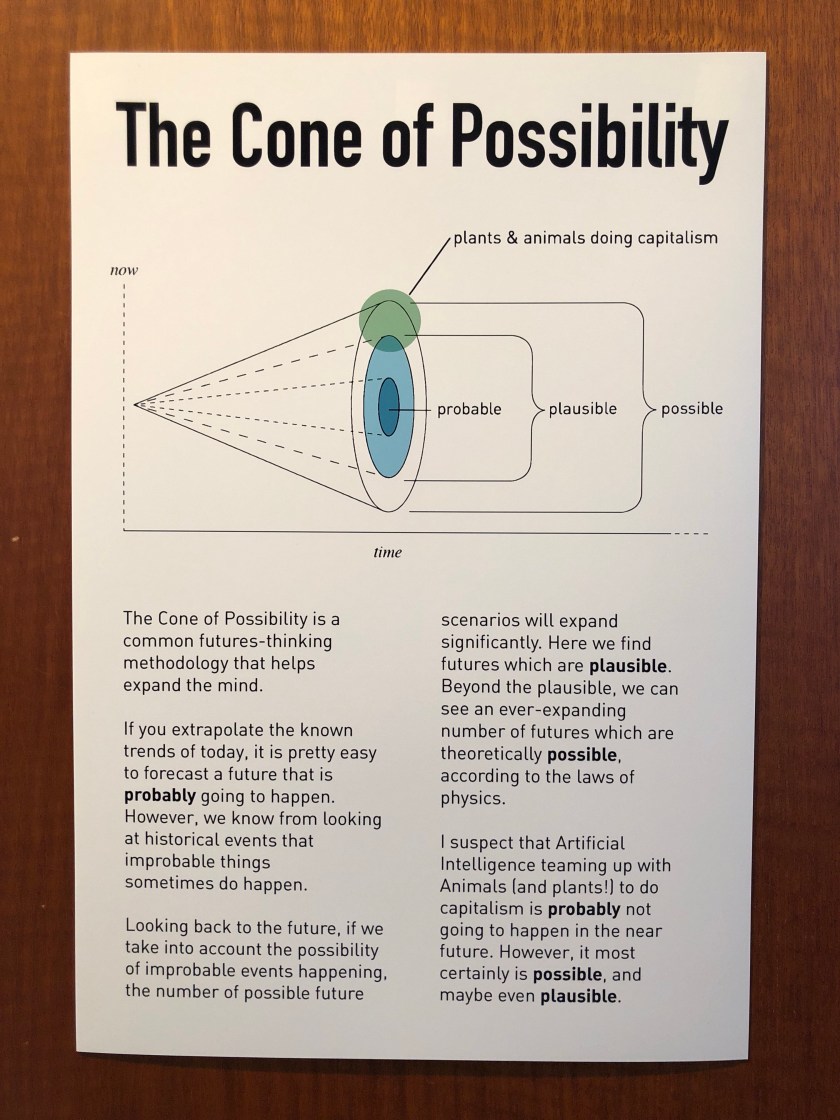
The Cone of Possibility
Project Update: We’ve Arrived at a Framework!
My editor, Uri, is back from his time away from the desk and we had a great call in which I updated him on my discoveries and conversations over the past two weeks.
I’ve landed on a framework not by industry (because those industries might not exist in 2050), and not by ideology (because that’s probably too abstract) and not tools (AI, for instance, will be a layer that affects many ways of life and governance, etc). So what breaks us out of traditional reporting constraints but isn’t too constraining is to organize by HUMAN NEED: to live, to love, to find community, etc.
This allows me to start with an exploration of the future human itself, physiologically, the human body and its need for water/food etc and then work outward to love and connection (dating, reproduction, sex and gender, etc) and then further outward to community and housing, and further outward to humans going from place-to-place and getting goods and services (transportation).
It also globalizes the work, it isn’t America centric. All humans share the same basic needs. This gives us a much wider audience possibility for video on streaming services or on YouTube and the like. Very exciting on that front.
We’re going to get going with ideas about how humans will actually function and be made in 2050 — likely with expanded physical and mental capacity as well as lifespan. Very exciting!
The premise is the oft-cited William Gibson quote: The future is already here, it’s just not evenly distributed. There are places where the future human is already evident or being experimented. That’s what we will begin our exploration doing/seeing. But we’ll also LOOK BACK to how predictions of thirty years ago about 2020 looked, and how they might have gotten things wrong and if so, why. It’s a nod to how even though we’re getting insight and helping people think about 2050, we also know we’ll be off the mark for reasons we aren’t anticipating.
Michael Chabon, on thinking much longer term
“This is the paradox that lies at the heart of our loss of belief or interest in the Future, which has in turn produced a collective cultural failure to imagine that future, any Future, beyond the rim of a couple of centuries. The Future was represented so often and for so long, in the terms and characteristic styles of so many historical periods from, say, Jules Verne forward, that at some point the idea of the Future—along with the cultural appetite for it—came itself to feel like something historical, outmoded, no longer viable or attainable.” —Michael Chabon, writing for LongNow Foundation
RE: How To Organize Areas of Inquiry
Since I want this to be centered around people as much as possible, what if we did it as each “chapter” around a human need?
To exist and survive
(cyborg-humans, future of war/migration)
To work
(will people even work? what if capitalism is dead by then?)
To eat
(genome editing leads to high-yield plants, etc)
To die
(aging, plus will we still die? will we live too long? ethics?)
To find love
(will our social institutions like marriage still exist?)
To get from place to place
(transportation)
To learn
(how knowledge is passed)
…and so on and so forth.
How do we organize our areas of inquiry?
I’m trying to figure out how to organize my exploration since “The Future” writ large is too broad. Do we organize this around people? Around the five senses? Around industries? I was thinking industries but then realized that capitalism may be over by 2050 so maybe industry is too constrained.
The Institute for the Future organizes itself research labs in these areas:
Science + Technology
Anticipate the strategic impacts of AI and robotics, virtual and augmented reality, a rapidly evolving Internet of Actions, and cutting-edge bio-engineering, alongside new materials sciences that tap the tiniest forms of matter.Economy + Environment
Leverage the evolution of a financialized society in a marketplace of distributed currencies and in an environment where the externalized costs of the past 50 years may be rapidly internalized by every organization.Work + Learning
Redesign the workforce to meet organizational needs as both automation and demographic shifts demand new contracts between learning machines and humans, between organizations and platforms that strive to get things done.Citizenship + Civic Systems
Rethink the interface between your organization and a volatile civic sphere where the rules for everything from regulation to cyber-security are being rewritten in the face of growing distrust in every level of governance.Food + Health + Well-Being
Grow your strategic leadership in a world of opportunities and pitfalls as the complex systems of health care, food production, and human microbiology transform our understanding of what it means to eat well and be well.
Arup Foresight, a consultancy that digs into future issues, has publications in these areas but they aren’t necessarily bucketed.
Just riffing here on potential directions…
Ideology: What is the governing ideology thirty years from now? (What values do people believe in, what brings them together as a society, etc)
Economy: How does the economy work? What drives it?
Power: Where are there centers of power?
Survival/Health: How much of a future human is no longer made of “natural” parts? How engineered are future humans, i.e. embryos? What has come of disease? What threatens the survival of the human race?
Environment/Earth: Does Earth sustain life as we know it? If not, where is space exploration/science at this point?
 Future Human